English - Writing
English - Writing
At Pinvin C of E Academy, our writing curriculum inspires pupils to become fluent, confident and purposeful writers. We want every child to communicate ideas, emotions and knowledge effectively whilst developing a lifelong love of language and literature. We also want pupils to develop a love of language (spoken and written) so that they can become creative and competent writers through engaging, inspirational and aspirational materials that support and challenge. It is our intention that pupils become more expert as they progress through the curriculum and through their schooling journey.
Chosen curricula:
Years 1 - 6
Our English curriculum is guided by the CUSP (Curriculum with Unity Schools Partnership) English Curriculum, which follows the principles of instruction, is guided by understanding how the memory works and cognitive load theory. This evidence-informed, carefully sequenced English curriculum maps core content in writing across the primary year groups. CUSP follows a CEEAC approach (Connect, Explain, Example, Attempt, Apply, Challenge) to ensure quality first teaching.
Through each unit, children are exposed to at least one high-quality model text, which helps them understand how to write the type of text expected of them. Audience and purpose are discussed throughout alongside understanding of vocabulary and grammatical techniques that further support text type and genre. Additionally, we intend for pupils to develop secure transcription skills, including spelling, handwriting and punctuation, alongside the ability to craft and refine writing for different audiences and purposes. The CUSP curriculum also ensures that children become increasingly independent writers who can plan, draft, evaluate and improve their work, developing resilience and pride in the writing process and enabling them for success in later life.
Long term overview:
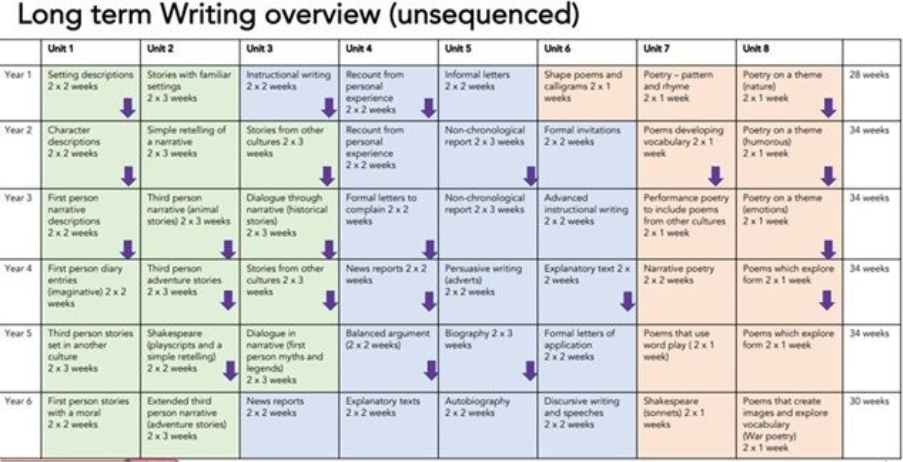
The long-term overview includes a reduced number of text types studied to ensure a focus on securing the grammatical structures that children need to be able to become great writers. Text types are revisited throughout the year to ensure that children have fully understood the teaching. Additionally, this allows children to move away from scaffolded learning to independent learning, supporting the learning theory and giving children the opportunity to master the execution of text types. Children learn that effective writers make deliberate choices about vocabulary, grammar, text structure and authorial techniques to achieve a specific purpose and effect on the reader which aligns strongly with the CUSP philosophy.
The CUSP curriculum ensures that there is deliberate proportionality in terms of narrative, non-narrative and poetry to ensure that children experience a wide range of literature and writing styles. In Year 1, there is a specific emphasis on poetry as this is a brilliant vehicle to teach. Academic text types (such as explanatory texts and discursive speeches) are deliberately woven into the curriculum as we aspire to prepare children for the demands of academic study.
The purple arrows in the unsequenced overview show where texts are introduced and where they will be studied last so that teachers are able to pick up on any gaps in children’s knowledge.
Rooted in our Christian vision and values, English provides opportunities for children to develop wisdom through reading, writing and speaking with confidence, purpose and creativity. Pupils learn to express their ideas, experiences and ambitions and become more hopeful about their future as they are able to find their voice and understand how the power of language inspires change. Respect, empathy and appreciation of diverse cultures, perspectives and experiences are also woven into our English curriculum as we encourage children to communicate thoughtfully, listen carefully and value the voices of others through a range of diverse texts.
Our aim is that every child leaves Pinvin as a confident, articulate and reflective communicator who can write with accuracy, craft and purpose. Equipped with a rich vocabulary and broad cultural knowledge, they are ready for the next stage of education and able to make a positive contribution to society.